
ByJohn A
A Beginner-Friendly Guide to Owning a Sauna Heater
Owning a sauna heater comes down to five practical decisions: sizing it correctly to your cabin’s cubic footage, confirming your electrical setup can support it, choosing a compatible floor and clearance, learning basic stone and steam care, and building a light maintenance habit. Get those five right and a home sauna heater runs reliably for well over a decade with minimal upkeep. Skip any one of them, especially sizing or electrical, and you end up with a unit that underperforms or needs early repair.
1. Size the Heater to the Room, Not the Guesswork
Heater output is measured in kW and needs to match the cabin’s interior cubic footage, calculated by multiplying length by width by height in feet. A small two-person cabin around 150 to 200 cubic feet typically needs 4.5kW to 6kW. A larger four-person cabin closer to 300 cubic feet needs 7kW to 9kW to reach a comfortable 170 to 190°F within 30 to 45 minutes. Manufacturers publish sizing charts for exactly this reason, and it’s worth checking the specific chart for the heater you’re considering rather than assuming your cabin falls neatly into a standard size, since ceiling height and window area both affect the real number.
2. Confirm the Electrical Setup Before You Buy
Most heaters above roughly 3kW need a dedicated 240V circuit installed by a licensed electrician, while smaller infrared units under about 1.8kW often run on a standard 120V outlet. Check your panel’s available capacity before ordering a heater, since discovering you need a panel upgrade after the unit arrives is a frustrating and avoidable delay. If you’re unsure what your existing wiring supports, a short consultation with an electrician upfront saves time compared to guessing and returning equipment later.
3. Get the Floor and Clearance Right
Concrete, tile, and solid wood decking with a heat-resistant pad all work as a base. Carpet and vinyl do not belong anywhere near the heater’s footprint. Every model specifies minimum clearance from walls and floor in its installation manual, commonly several inches from combustible surfaces, and a guard rail around the unit is standard practice both for safety and to keep towels or loose fabric away from the hot surface. This is one of the cheaper parts of ownership to get right the first time, since a heat pad or a properly rated floor costs little compared to the heater itself.
See also: How to Create a Business Growth Roadmap
4. Learn Basic Stone and Steam Habits
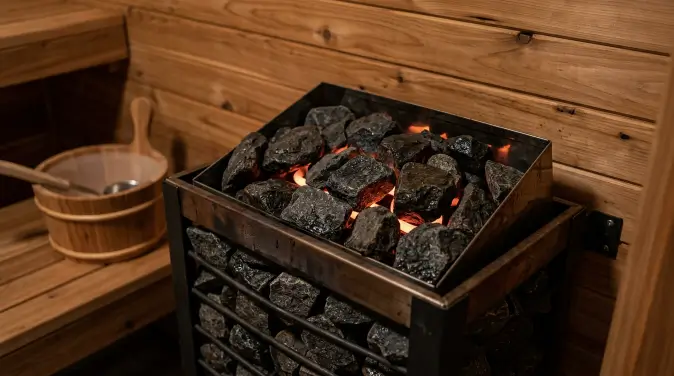
A heater loaded with roughly 40 to 50 pounds of sauna rocks holds heat far better than a bare element, which matters for both comfort and even heat distribution across a session. Pour water on the stones in small amounts, about a quarter cup at a time, rather than dousing them, which can send an uncomfortable blast of steam and stresses the heating element over repeated use. Rocks gradually break down from the thermal cycling of heating and cooling, so expect to rotate or replace them every one to two years depending on how often the heater runs.
5. Build a Light Maintenance Routine
Sauna heaters are mechanically simple compared to most home appliances, which is part of why they last so long with so little attention. Wipe down the exterior housing periodically, check the door seal for gaps once or twice a year, and inspect the guard rail for any looseness. If the unit takes noticeably longer to reach temperature than it used to, that’s usually a sign the stones need replacing rather than a sign of a failing heating element, which is a much less common issue.
What Should a Beginner Budget for the First Year?
Beyond the heater itself, budget for electrical work if needed (commonly $300 to $800 for a straightforward 240V circuit), a heat-resistant floor pad if installing on a deck, an initial set of stones if they’re not included, and modest monthly running costs, typically $10 to $25 depending on heater size and usage frequency. None of these are large individually, but planning for them upfront avoids surprises partway through the install.
6. Keep the Documentation That Protects the Warranty
Most manufacturers require proof of purchase and, for larger heaters, proof of proper electrical installation to honor a warranty claim. Save the receipt, the installation manual, and if a licensed electrician did the wiring, a copy of that invoice or permit if your area requires one. Warranty terms often specify a minimum clearance and circuit rating too, so an installation that skips the manual’s specs can void coverage even if the heater itself is otherwise undamaged. This is a five-minute filing task when the heater is new and a genuine headache to reconstruct years later if something fails and you need to make a claim.
Is a Used Heater Worth Considering?
Sometimes. A used heater can be a reasonable way to save money if the element and stones are in solid shape and the unit’s voltage and amperage match what your panel can support. Ask about age, whether it’s been run consistently or sat idle, and confirm it carries recognized safety certifications before installing it. When in doubt, the team at SweatDecks and similar sauna-focused retailers can usually help identify whether a specific used model is still a safe, supported choice before you wire it in.
Frequently Asked Questions
What is the biggest mistake first-time sauna heater owners make? Undersizing the heater for the cabin’s cubic footage. An undersized heater runs constantly, struggles to reach temperature, and shortens its own lifespan from overwork.
How often do sauna stones need to be replaced? Roughly every one to two years for regular use, sooner if you notice stones cracking, crumbling, or the heater taking noticeably longer to reach temperature.
Do I need a professional to install a sauna heater? For any heater requiring a 240V circuit, yes, a licensed electrician should handle the wiring. Smaller 120V infrared units can often be plugged in without professional installation.
How much maintenance does a sauna heater need? Not much. Periodic stone rotation, wiping down the exterior, and an occasional check of the door seal and guard rail cover most of what’s needed for years of reliable use.
Is a used sauna heater a reasonable way to save money? It can be, if the heating element and stones are in good condition and the unit’s wiring matches your available circuit, but always confirm the model’s safety certifications before installing a used heater.
References
- Hussain, J. N., et al. “Cardiovascular and Other Health Benefits of Sauna Bathing: A Review of the Evidence.” Mayo Clinic Proceedings, 2018. https://pubmed.ncbi.nlm.nih.gov/30077204/
- Kunutsor, S. K., et al. “Clinical Effects of Regular Dry Sauna Bathing: A Systematic Review.” Evidence-Based Complementary and Alternative Medicine, 2018. https://pubmed.ncbi.nlm.nih.gov/29849692/
- Hussain, J. N., et al. “Does the Combination of Finnish Sauna Bathing and Other Lifestyle Factors Confer Additional Health Benefits? A Review of the Evidence.” Mayo Clinic Proceedings, 2023. https://pubmed.ncbi.nlm.nih.gov/37270272/
By Priya Nakamura
